There’s certainly something to be said about the way wrestling presents itself today. Of the most viewed wrestling in the world, 4k cameras, glossy white lights, and abundant advertisements cover their entire productions. In these places, commentary is insultingly direct, and the majority of the wrestling feels soulless and robotic. The larger medium has never felt so desperate to include everyone, and it has never shoved anyone attempting to form critical thoughts aside so sternly. Never once has it been this easy to criticize either; a hilarious prospect within itself because there was a time the mainstream media was given metaphorical crates of ammunition once they were confident enough in themselves to say wrestling is “fake.” But I get it, we live in a world where you’re told you can be anyone or anything, and honestly, I prefer that to any other realistic alternative. There’s no need to be doom ‘n gloom about everything, and when it comes to wrestling, I still think there’s bits and pieces to be liked here and there, while the on the nose nature does lend a favorable predictable nature to the usage of my time.
But there is one thing about the standing of modern wrestling that bothers me the most. Set aside the obvious corporate and political nature, the hyper fixation on maximalism, and the obsession with expectations and reality aligning, and what’s so lost is the beauty of flaw in wrestling.
But hold that thought.
Nostalgia can be dangerous, and pushing aside the popular products just for the sake of doing it doesn’t simply lead to a promised land. Dragon Gate USA is a perfect example. All kinds of talent flowed through this extension of the Gabe Sapolsky cannon, from DG greats such as Shingo Takagi, Akira Tozawa, and Masato Yoshino, to American Indie legends like Bryan Danielson, Davey Richards, and Chris Hero. Through it’s five year existence it had more talent run through it than it ever had any business getting, and it turn it produced less good wrestling than it should’ve. Hell, the person who ended up doing their best work here is, I don’t know, Sami Callihan, which, for obvious reasons is gross to have any gleaming fondness for. But whatever, if you think it’s someone else, fine, make your argument. There’s a good chance you know better than me anyway, but one thing I am confident in saying is that I know this isn’t where Jon Moxley or Jimmy Jacobs did their best work.
Starting to see how this loops back to flaw?
Let me lay this out a bit more though, and do the actual match review part. This is a “I quit” match, and it serves as the end to a lengthy program between the two. The feud itself isn’t reinventing anything, it’s a classic older guy sees himself in a younger guy and wants to stop him thing, but it’s hardly a bad example of it. Jacobs’ promos that paint a picture of his drug and anger fueled past are damn great if you can track them down, and they’re also the perfect contrast to the character Moxley was expanding upon around the time. Naturally, the matches and meetings between these two leading up to this range from solid to good as well, but as foundation to this, I’d dare to say there great in their own right. All that said, this is far from the peak of what either man is capable of aside from a few flashes. Mox’s punches look just OK, it does rush and drag in some of the transitional moments, and there’s certainly more to be given from the selling from Jimmy. Far from perfect in more ways than one, leaves you wanting more, but that’s not the point.
It is soulful, non-robotic, as direct as you want it to be, and has the dirt under the nails that makes it as far from “fake” as you can imagine.
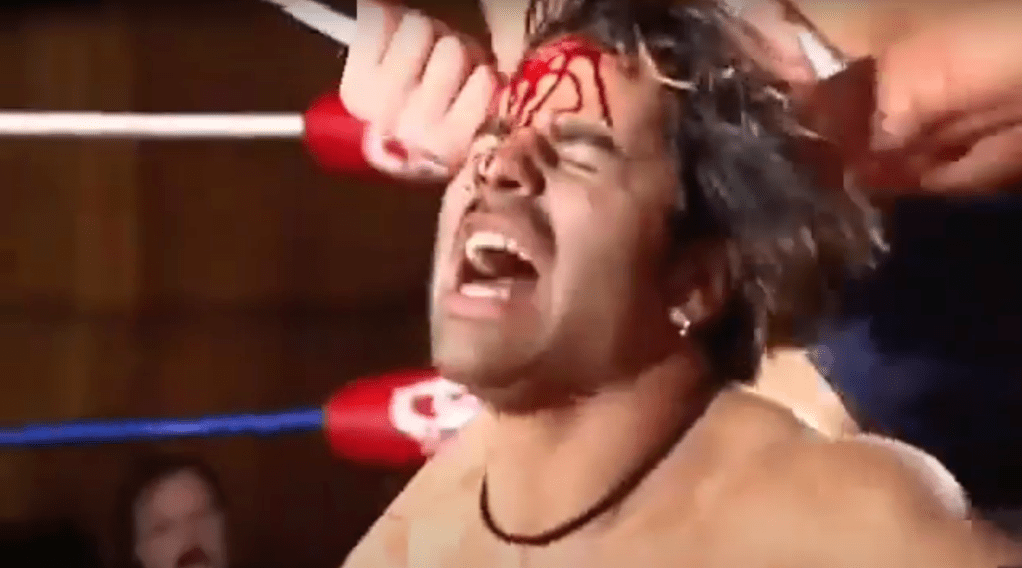
Seriously, it’s a lovely piece of wrestling. The hot start with Jacobs diving off the balcony being a short winded advantage is a excellent example of both men understanding where they are in their story leading in. The simplicity and poignancy of the weapons respects the logic of the viewers too, and once Jimmy’s blood starts flowing this thing levels up both visually and narratively. Soon the veteran’s advantages become shorter and shorter lived, Moxley’s manic behavior becomes more and more unhinged, and things just look worse and worse for our hero. Everything feels like it’s off the table, and that the match is creeping towards the painfully direct march you’d see in matches like Page/Strickland, that is until the spike Mox jammed into the turnbuckle in the early moments is ripped out of its resting place and transferred into his skull. It’s a perfectly feasible transition in control where so many violent matches miss the mark, and for someone (like me) who was wanting to watch in that critical sense, you get into the thought process of, “oh, this is how he wins, that makes sense, nice.”
Then another cruel, yet delightful twist.
Jacobs gets a bit too fancy. He gets away with a strike exchange. Gets away with a telegraphed ace crusher. He even goes back to the spike, and that doesn’t cost him either. But never once, in his longest segment of control, does he go for the win. In what feels like a instant, all the blood loss catches up to him, and the younger, faster, more physical man draws even. He knots Jacobs’ hands behind his back Houdini style, then thunders down on him with his fists, and eventually the spike in what is one of the most visceral and guttural spots you’ve ever seen.
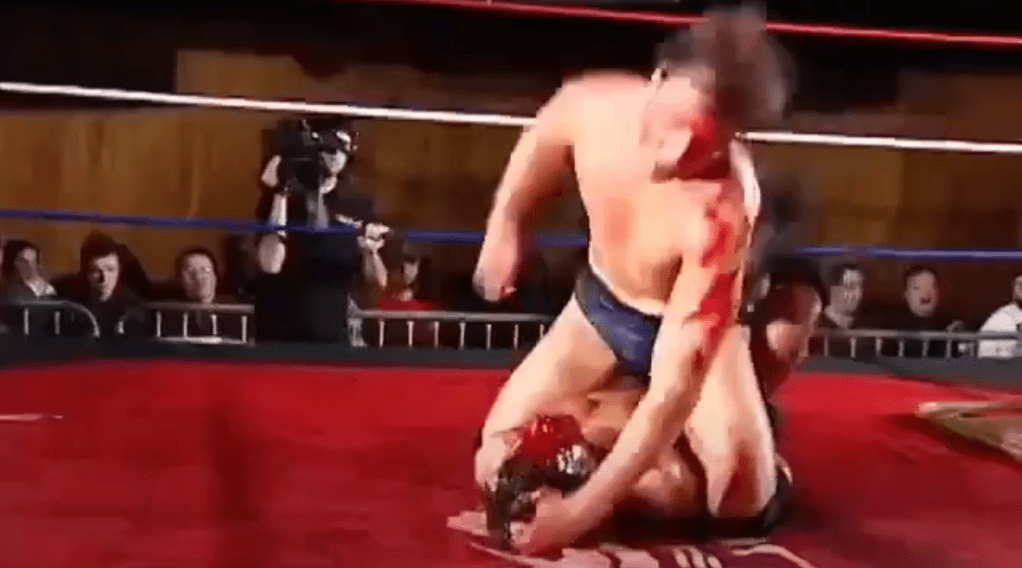
Image via DGUSA
It’s a rare singular spot that pushes a match to another level, a preview of the true maniac Mox can be, but still it goes a step further as they realise it. Moxley, forever the mirror of Jacobs, makes the same mistake his veteran counterpart made minutes earlier. He doesn’t try to win. He lets Jimmy find the second wind, he hits a low blow, digs deep and finds the hatred, and digs the spike into Moxley’s groin until the bastard quits. He wins, it’s immediately satisfying, but it does leave one to wonder. Mox pushed our hero far enough at the end, tortured him endlessly, and walks away losing nothing, because he had no pride to lose. All of that depth in 13 minutes, and as much as I hate to use the wrestling critics cliché, both men walk away in better standing than they were coming in. Not a booking triumph because this is DGUSA we’re talking about, no, this is a triumph is finding the beauty in flaws. It’s awkward at times, literally as mic doesn’t work initially when Moxley cuts his promo at the start, and spiritually as there’s a giant YAMATO banner hanging in the background as if it’s a microcosm of that old saying of “the more things change the more things stay the same.” But it sticks with you, peaks at every opportune moments, and dreadful similarities between then then & now be damned, this is a good omen, and glimpse of the demons that define both men’s future.
The very best matches succeed in spite of things.
Rating: ****1/4
 Kyle Ginsbach